
Line of struggle
Campaigns and charter
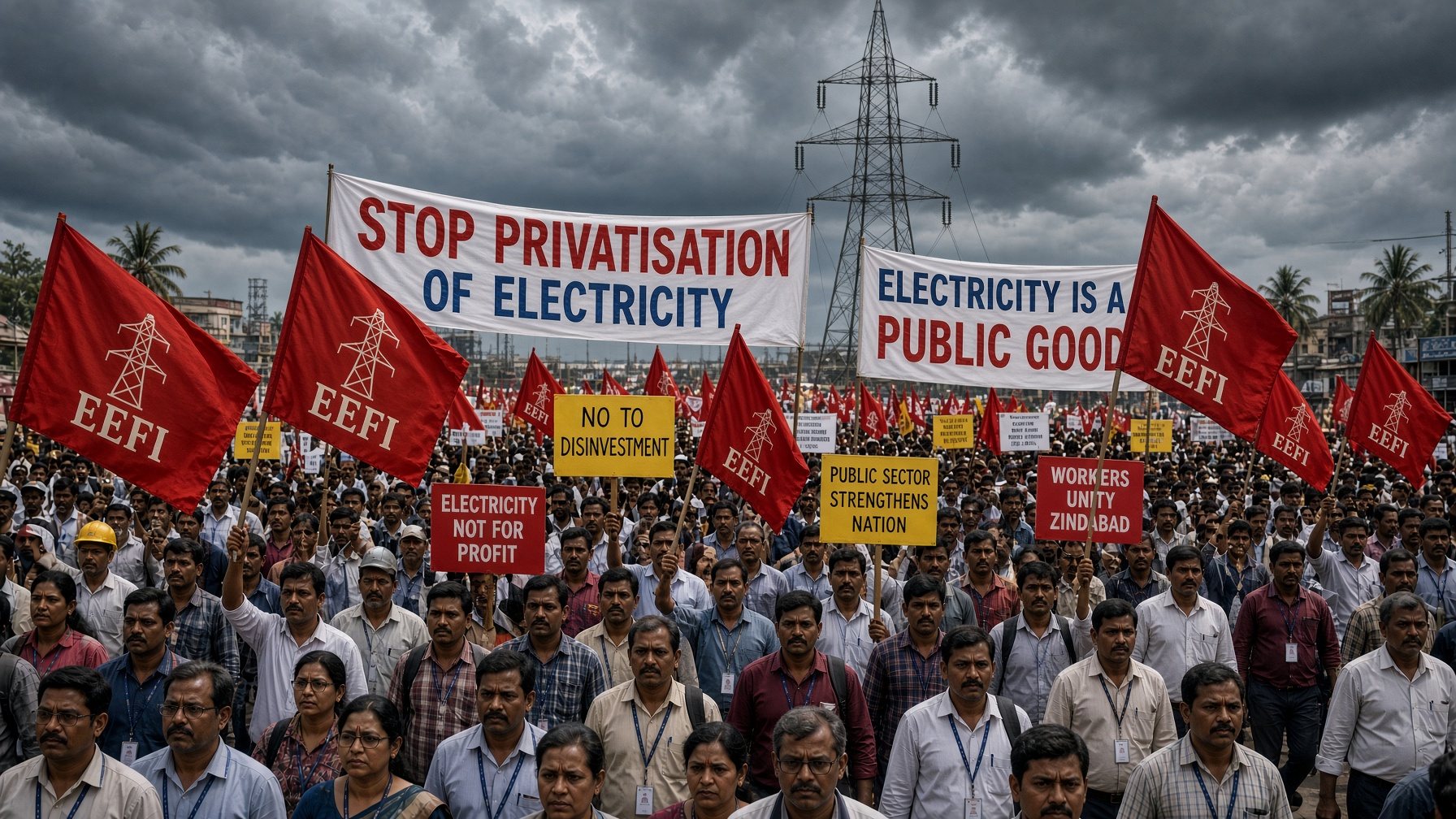
Adopted and restated at the 10th National Conference, Thiruvananthapuram, 10–12 March 2025.
- 1
Stop privatisation of generation, transmission and distribution.
- 2
Scrap the Labour Codes and the Electricity Amendment Bills.
- 3
Regularise every contractual electricity worker immediately.
- 4
Equal wage for equal work, as held by the Supreme Court.
- 5
Stop tariff hikes that punish households and farmers.
- 6
Restore the Old Pension Scheme for public power employees.
- 7
Keep renewable energy in public ownership.
- 8
Guarantee the right to electricity as a public good.
Campaign line now in force
From Circular 01/2026 of the Office Bearers (New Delhi, 20 May 2026), read with the Working Committee at Ooty (Circular 04/2025).
Public power
Stop the Electricity Amendment Bill. Stop the sale of DISCOMs. Halt parallel distribution licences in Maharashtra. Defend the Puducherry Electricity Department. Resist the carving-out of agricultural feeders into separate DISCOMs in Telangana, Haryana and Maharashtra. Keep civil nuclear work in public hands after the SHANTI Act.
Labour Codes and the workplace
Resist the Codes wherever a State government or a management tries to impose them. Defend pay revision, the Old Pension Scheme and recruitment. If the Amendment Bill is forced through Parliament, multiple-day united action under NCCOEEE.
Contract workers
State conventions on contract labour. A one-day national strike of contract workers in the power sector in October–November 2026. Regular work, equal wage for equal work, an end to fatal accidents on outsourced lines.
Employees and consumers
Build Electricity Employees’ and Consumers’ Associations in every state. Joint work with kisan organisations. Take the Amendment Bill, prepaid smart metering and tariff shocks to the household and the farmer — not only to the union hall.
One energy sector
Common road-map with the coal and petroleum-gas federations. General Council of EEFI, Kolkata, 3–4 October 2026.
Why these demands sit together
Sudip Dutta told the Kolkata meeting that the attack on generation, transmission and distribution — Central, State and private — is one offensive. Coal-import burden and prepaid smart metering are parts of the same privatisation move. The struggle has to be integrated in the same way.
The Electricity Act, 2003 unbundled the State Electricity Boards. DISCOM losses mounted. Ultra-mega projects, coal-block allocations and gas contracts shifted public resources into private hands. The Amendment Bills of 2020–2022 try to finish that job: franchisees, market trading, and the weakening of cross-subsidy that still keeps rural and agricultural supply alive.
Contractualisation is the workplace face of the same policy. Equal wage for equal work is not a slogan invented by the federation — it is a Supreme Court holding that Boards still evade. Regularisation, the Old Pension Scheme, and a halt to tariff shocks on households and farmers are the concrete claims that follow.
Three-prong attack
Technology and jobs
Automation, remote substations, drones, SCADA, prepaid smart meters and AI are cutting meter-reading, billing and maintenance posts. A thermal megawatt still needs two to three workers; a solar plant can run 20 MW with one. The demand is shorter hours and training — not redundancy.
Privatisation in many forms
Fifty-two percent of generation is already private. The National Monetisation Pipeline, franchisees, Market Based Economic Dispatch and the Electricity Amendment Bills are one offensive on DISCOMs, POWERGRID and public renewables.
Employment structure
Core work is shifted to contract, fixed-term and trainee labour with no right to unionise. Electrical accidents rose from 11,938 in 2013–14 to 13,855 in 2021–22 as vacancies stay open.
Three pillars of resistance
- Defend existing rights, fight for new ones, keep the workforce united — including the 72,000 contract workers regularised in Tamil Nadu over fifty years.
- A total fight against privatisation — Monetisation Pipeline, outsourced substations, privatised smart meters, Amendment Bills and sale of DISCOMs.
- Organise permanent and contract workers together, link the workplace to consumers, and prepare national strike action.
United action already taken
- National Convention of Workers, New Delhi, 18 March 2025 — Central Trade Unions.
- Nationwide strike of power employees, 20 May 2025, against the Labour Codes.
- Power-sector strike, 26 June 2025, on electricity-specific issues.