
Articles · President, EEFI
Empowering unity: challenges and opportunities in India’s electricity sector
Elamaram Kareem
Address to the 10th National Conference. Return to Thiruvananthapuram. Forty years of EEFI. Centenary of the founding President.
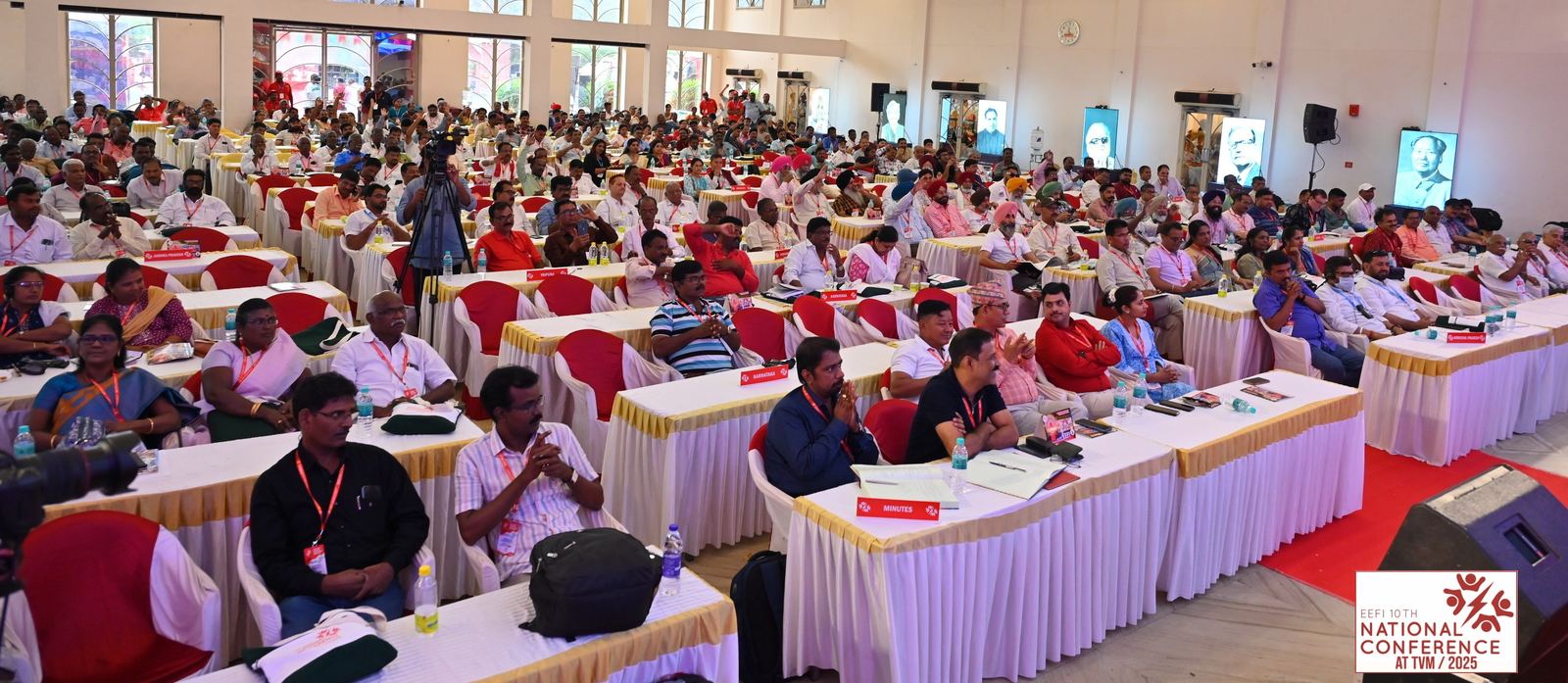
The 10th National Conference is not a routine sitting. It is a return to the city where EEFI was founded in 1984, and a homage to Comrade E. Balanandan, founding President, in his birth-centenary year.
The NDA years have put corporate profit above public power. Coal-import invoices, solar-farm contracts, the National Monetisation Pipeline, coal blocks sold cheap, border and “renewable” clearances written for a few houses — these are not accidents. They are a policy.
More than half of generation is already private. Renewables are almost wholly private. Installed capacity is above 4.5 lakh MW; peak demand has not crossed 2.5 lakh MW; yet load is cut and the exchange price has touched ₹18–20 a unit. Transmission is being bid out under TBCB with public-bank money, and 28,500 circuit kilometres are listed for sale. Distribution amendments have been held only by the all-India unity of employees and engineers.
Uttar Pradesh and Uttarakhand have seen ESMA. Farmers have stood on the same demand: withdraw the Electricity Act amendments. The Nagpur convention of NCCOEEE fixed the next dates with the central trade unions and a separate power-sector strike. Contract labour must be organised. Communal division must be answered with class unity.
Kerala remains the public alternative: lowest AT&C losses, full electrification, assembly resolutions against the Amendment Bill, a CAPEX smart-meter path that does not hand metering to a vendor. That is the benchmark this conference carries back to every state.