
Articles · Former General Secretary, EEFI
Our EEFI and Comrade Balanandan
Prasanta N. Chowdhury
A delegate at the foundation conference remembers the first President, the SEBs, BHEL, Enron, and the birth of NCCOEEE.
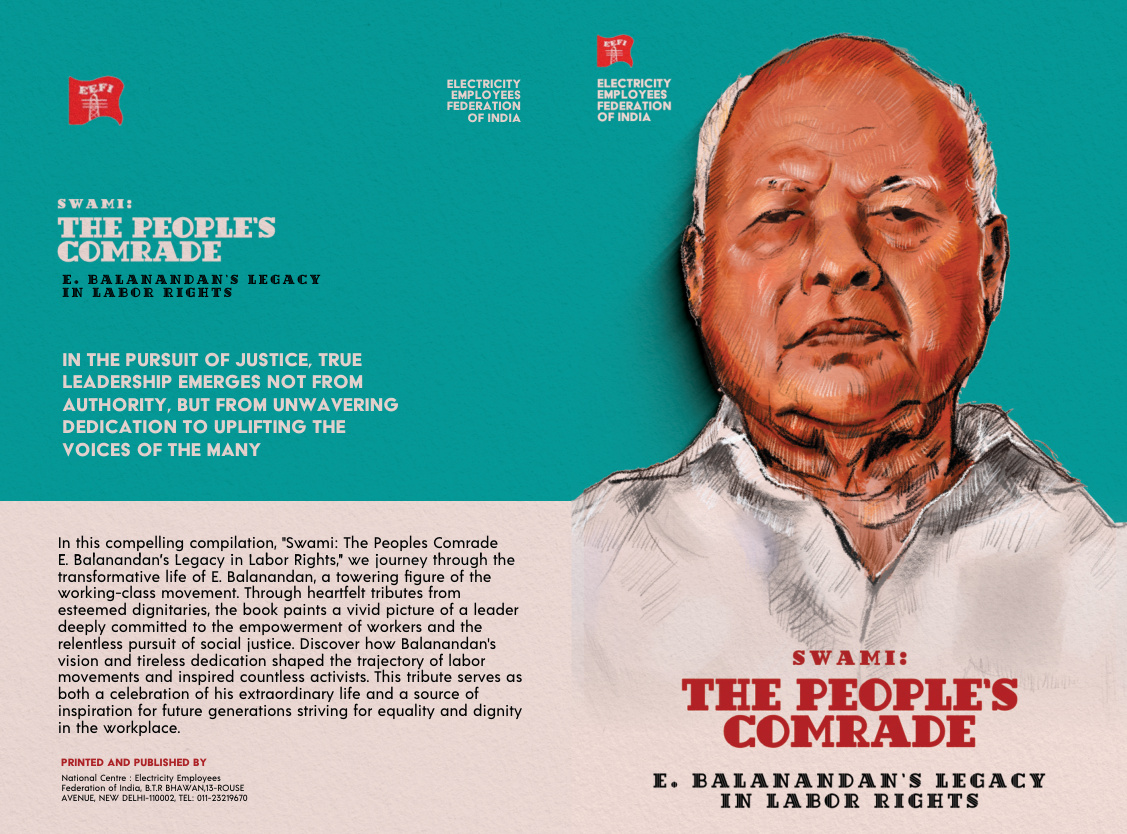
This year marks the birth centenary of Comrade E. Balanandan and four decades of the Electricity Employees Federation of India. As an activist of the West Bengal power sector I was a delegate at the foundation conference in Thiruvananthapuram, 13–15 January 1984. B. T. Ranadive and Comrade Balanandan sat with us. From the first day the federation was given one task: oppose anti-people measures dressed as power-sector reform.
In those years the Boards were not yet being sold. The charge against them was “loss.” That charge ignored the Electricity (Supply) Act, 1948. The SEB was not a shop. It was the instrument of a country coming out of colonial rule: electrify agriculture, industry, transport, health and education. Per-capita consumption rose from 15–16 units to a hundredfold. National and regional grids were tied with high and extra-high tension. That work was public work.
Comrade Balanandan began as an electrician in Kerala. He taught the federation the sector, the worker and the imperial use of technology. Heavy electrical plant had to be made in India. BHEL’s turbo-generator line with the Soviet Union built capacity at home and in other developing countries. Western pressure then pushed Siemens, a thinner transfer of know-how. P. Ramamurthy took it to Parliament. Balanandan took it to the units and to the public.
GATT, private generation, Enron, Ultra Mega Power Projects built with public money and handed to foreign capital that then borrowed from Indian public institutions — EEFI, under his guidance, put each of those facts before the people. When the first NDA government brought the Electricity Bill 2000, he and A. B. Bardhan called a national convention at Jaipur on 30 April 2000. NCCOEEE was born there. It still stands.
The Nagpur convention of 23 February 2025 resolved to stand with the central trade unions and the Samyukt Kisan Morcha against the Labour Codes, and to act against privatisation and the TOTEX prepaid-meter model. That is the same line he taught us.