
News · 3 October 2026 · Conference · Delhi
Oppose the Labour Codes and the anti-worker, anti-people policies of the Centre: Elamaram Kareem
Presidential address at the first General Council, Kolkata. The burden of the crisis is being placed on workers and the people. The answer is organised struggle, including Occupy Delhi from 1 December.
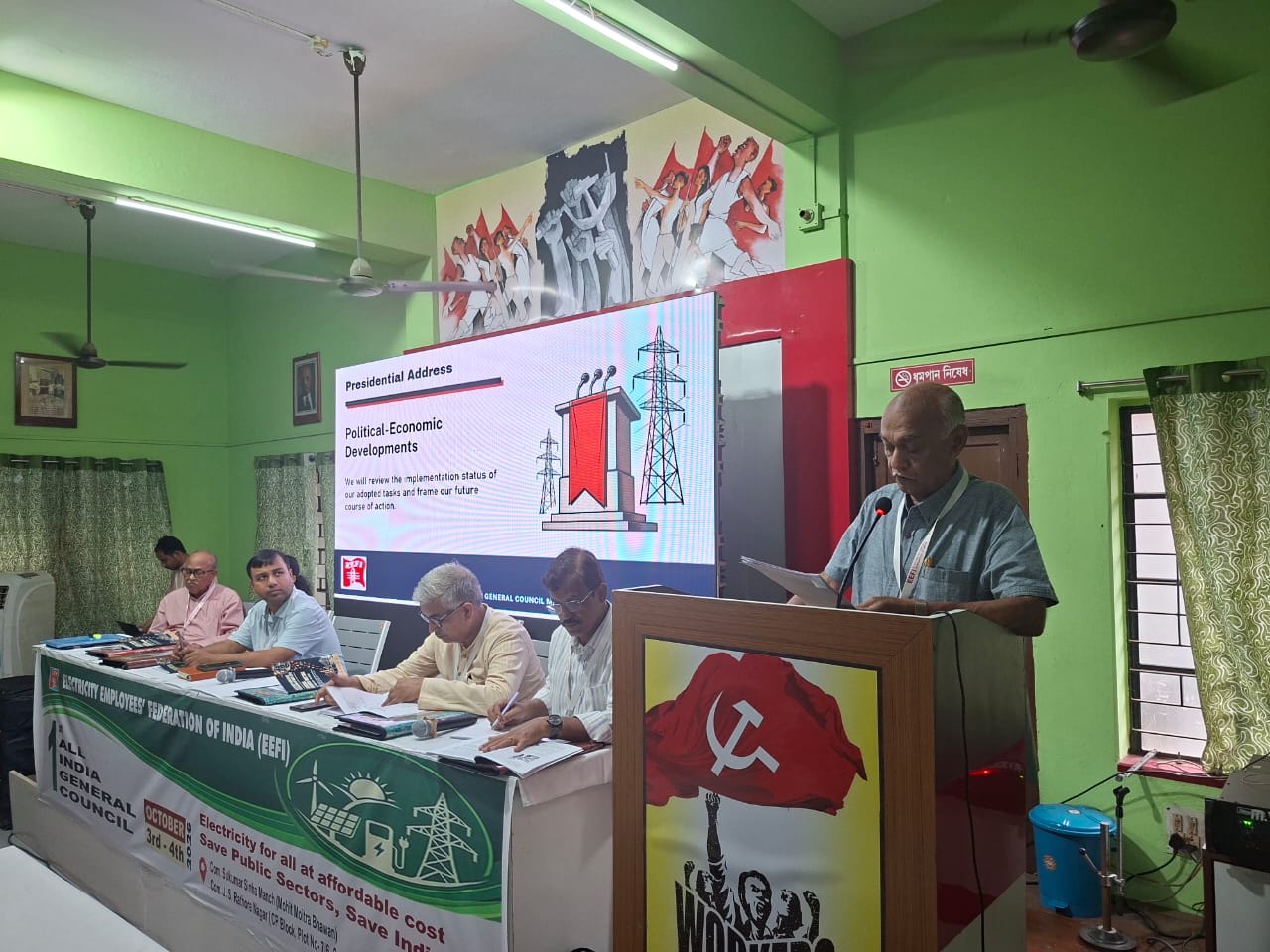
President Elamaram Kareem delivered the presidential address at the first All India General Council of the Electricity Employees Federation of India on 3 October 2026 at Com. Sukumar Sinha Manch, Com. J.S. Rathore Nagar, Kolkata. The council meets on 3 and 4 October.
He placed energy at the centre of the present geopolitical turmoil. From the Strait of Hormuz to the scramble over renewables, grids, minerals and data centres, the contest is public access to energy against private control. The task he set is affordable energy through public ownership, energy sovereignty and democratic control of the transition.
World capitalism, he said, is in a prolonged crisis of stagnation, unemployment and inequality. It tries to manage that crisis by war, by speculative technology including artificial intelligence, by squeezing weaker producers, and by shifting the cost onto workers — retrenchment, wage cuts, longer hours and weaker labour rights. Artificial intelligence does not resolve this. It concentrates profit in a few corporations, cuts employment, and drives a new demand for electricity, land and water.
India is being made to carry that burden, and the Union government is passing it on to the people in the interest of the big corporate houses. Crude import dependence remains near 88 percent. War, tariffs and unequal trade agreements have hit prices, the rupee, Gulf remittances, and jobs in textiles, gems, seafood, auto components and engineering. Celebrated growth figures do not match the life of the worker. Food and fuel are dearer. Urban unemployment is higher. Real wages are stagnant. MGNREGA has been withdrawn. Gig and platform work expands without rights. When the ILO adopted standards on decent work in the platform economy, the Government of India abstained.
The Centre’s answer has been further concession to monopoly capital: tax relief, production-linked incentives, the National Monetisation Pipeline, disinvestment, transfer of public infrastructure, land acquisition, and eviction of hawkers and the working poor. Data centres are being invited onto Indian land, power and water, with very little permanent employment. Farmers face higher power prices, the Seed Bill, trade concessions and the diversion of foodgrain to ethanol, while fertiliser and input costs rise with the West Asia crisis.
On the Labour Codes he was direct. The last six months have opened a new labour regime. The Codes, described even in the Economic Survey as a shock absorber for the economy, weaken protection, reduce inspection, extend working hours, undermine trade unions and depress wages in organised and unorganised work alike. Workers are already dying in industrial accidents — the boiler explosion at Vedanta’s plant in Chhattisgarh, molten steel at Visakhapatnam, the ammonia leak in Tamil Nadu, the rat-hole mine in Meghalaya, the explosives blast in Nagpur, the warehouse collapse in Kolkata, the quarry in Karnataka. Trade union activity is being criminalised while violations by employers are let off. This, he said, is the beginning of a murderous labour regime, and EEFI must reorient its work to confront it.
Communal polarisation, he said, is the other weapon: a diversion from wages, jobs and public services. Defending communal harmony is part of the same struggle. The Special Intensive Revision of electoral rolls threatens to disenfranchise large sections of the exploited and the oppressed and to deny them welfare.
Resistance is already on the street. The Bharat Bandh of 12 February 2026, called by the Joint Platform of Central Trade Unions with the Samyukta Kisan Morcha, demanded withdrawal of the four Labour Codes, the Draft Electricity (Amendment) Bill, the Draft Seed Bill and the SHANTI legislation, restoration of MGNREGA, and scrapping of the VB-G RAM G scheme. EEFI stood in the forefront. Young non-regular workers across north and central India, in centres such as Gautam Buddha Nagar, Manesar, Neemrana and Faridabad, have come out against 12-hour shifts and the denial of statutory wages, and have won revisions after years.
The General Council, he said, is to consolidate the unions, take class politics to the workers, and keep a visible presence on the street. In that line the Office Bearers have conceived the Occupy Delhi movement from 1 December 2026: one lakh workers to assemble in Delhi and march towards Parliament. Electricity workers are called to unite across regions and sectors, and to join livelihood struggles with the fight against communal division. The full presidential address, as placed before the council, is published here. The other papers of the meeting are not released with this note.
Issued by
EEFI Centre