
News · 3 October 2026 · Conference · Bihar
Organisational report: expand utility by utility, organise the unorganised — Sudip Dutta
General Secretary Sudip Dutta placed Part I of the report at the first All India General Council, Kolkata, 3 October 2026. Jharkhand has applied to affiliate. Bihar is back in the council. The Karnataka contract workers met on 29 September.
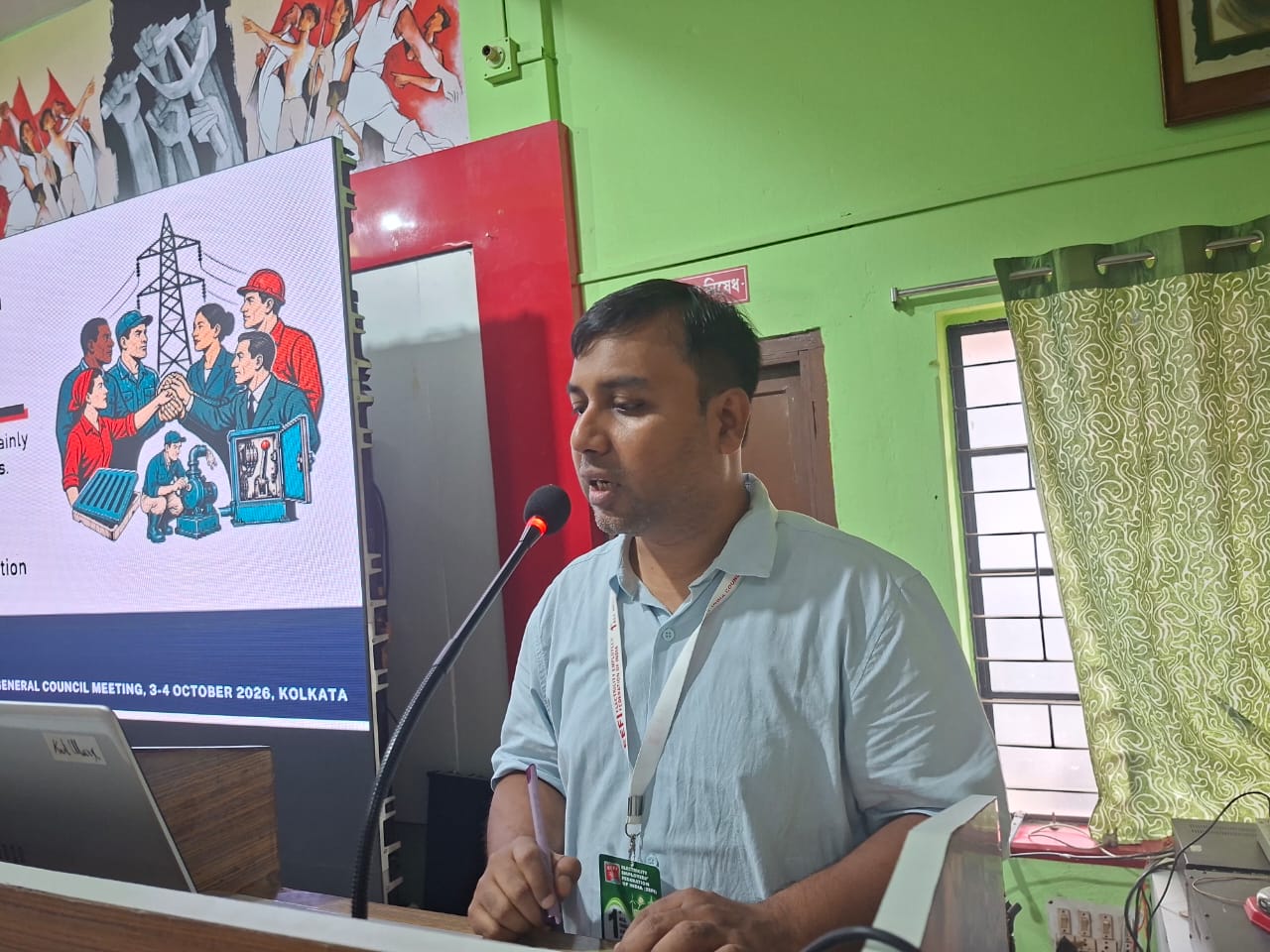
On 3 October 2026 General Secretary Sudip Dutta placed the organisational report, Part I of the General Secretary’s report, before the first All India General Council of the Electricity Employees Federation of India. The council meets on 3 and 4 October at Comrade Sukumar Sinha Manch, Comrade J.S. Rathore Nagar, Kolkata. From the podium he set out how the organisation is to grow. The clip with this note is that part of the report.
The report carries forward the priorities fixed at the 9th and 10th conferences: a united movement of regular and non-regular workers; coordinated action of workers in generation, transmission and distribution; joint action of electricity employees and engineers under NCCOEEE; and one struggle of the energy sector — EEFI, the All India Coal Workers’ Federation and the Petroleum and Gas Workers’ Federation of India — with a clear knowledge of the industry, the technology and the policy.
Democratic functioning is treated as the base of the organisation. Working-class democracy, the report says, is not a mechanical method and not a matter of numbers. It is the conscious unity of the whole organisation, guided by a definite ideology and politics. The National Committee is to be lifted from union-level consciousness to the consciousness of the federation and the industry, and then towards a wider class consciousness. Office-bearers are to meet at least once in three months, and the Working Committee at least once in six. The year’s plan is three meetings of office-bearers, three of the Working Committee, two regional meetings and one General Council. Four online meetings of office-bearers and one extended online meeting were also held. Prior notice, written reports and financial reports are placed regularly. The report asks that the discussion on organisational tasks be taken more fully when those meetings sit.
After the 10th Conference the EEFI Centre was constituted with Comrade Elamaram Kareem, Comrade Sudip Dutta, Comrade Swadesh Dev Roye, Comrade Subhash Lamba, Comrade S. Rajendran and Comrade Jay Prakash Sharma. In May 2026 the Centre was reconstituted, with Comrade Subhash Lamba in charge of day-to-day functioning. The Kerala and Tamil Nadu unions have each promised one comrade to strengthen the Centre. The report says that without a strong, modern Centre, with research and the tools of the present day, the Federation cannot meet the policymakers and their corporate masters, and that this General Council has to begin that work. Four regional committees are formed. The Northern Region is with Comrade Subhash Lamba, the Southern with Comrades C. Unnikrishnan, S. Harilal and S. Rajendran, the Eastern with Comrade Arindam Roy, and the Western with Comrade Sudip Dutta. Regional in-charges are to keep a live link with the unions and to send a written report to the Centre seven days before every meeting of office-bearers and the Working Committee.
Seven sub-committees were formed so that the Federation’s work is collective. Comrade Deepa K. Rajan is National Convener of the Working Women Sub-Committee, elected at the 10th Conference. Comrade Harpal Singh was elected National Convener of the Youth Sub-Committee at a convention in Hyderabad on 24 August 2025. A guideline on Internal Complaints Committees in the unions is to be circulated from this meeting. The General Council is asked to make each sub-committee a working body.
The expansion, as the General Secretary placed it, has four steps. Each union is to plan, in a systematic way, where it can grow inside its own utility, and then to reach other utilities in the state where EEFI has no union. The map has to be utility-wise, industry-wise and company-wise. The second step is the non-regular worker. Contract and other non-regular workers are still largely unorganised, and the report asks the unions to identify them, set a yearly target, and register a separate union where that is what the work needs. The third step is to find independent organisations and bring them into EEFI, with a named office-bearer in each union responsible for that work. The fourth is the power engineers. Engineers are with EEFI in KSEB and in Tamil Nadu. The decision is a nucleus of power engineers in every utility. Kerala, Odisha and West Bengal have reported contact with other utilities in their states.
Where EEFI had no organisation — Jharkhand, Madhya Pradesh, Chhattisgarh, Uttarakhand, Gujarat, Karnataka and some of the north-eastern states — the task is to form a nucleus. The President, the General Secretary, Comrade Swadesh Dev Roye, Comrade Subhash Lamba and the regional conveners were given this work. The General Secretary reported the advance. In Jharkhand, one of the largest electricity unions, working in distribution, met the Federation, agreed to work with EEFI, and has applied for affiliation. This is the first step in the Jharkhand DISCOM. Two comrades from Jharkhand are attending this General Council. In Bihar the union had been away from the Federation’s functioning for several years, after its earlier leader was ill for a long time and then passed away. A meeting restored the connection. The union has been revived and is in this council, with two comrades present. In Karnataka the contract workers’ union held its conference on 29 September 2026 and is being reconstituted. Comrade Varalakshmi, General Secretary of the Karnataka state committee of CITU, and Comrade Kading attended that conference with the General Secretary. The Odisha Power Sector Technical Employees’ Union, Balasore, was affiliated at the last Working Committee. Unions in the distribution utilities of Thrissur Corporation and the Kannan Devan tea estate, and the Electricity Wiremen and Supervisors’ Union of Kerala, are to be brought in. Two unions in Andhra Pradesh that stood in the joint struggle are to be approached. Two thermal plants in Jharkhand are reported to be coming in. A further union in Odisha is expected to apply. The union in Uttar Pradesh has held its conference, and expansion there is being planned. While these new areas are consolidated, the report asks the organisation to enter Chhattisgarh, Madhya Pradesh and Uttarakhand without delay.
India’s private power sector is growing fast, and EEFI’s presence there is still small. From the last conference the task has been to form organisation in private utilities. Tamil Nadu is developing contacts in wind generation. A meeting is to be held in Kerala to plan organisation in renewable energy. A primary contact has been tried with workers of the Adani DISCOM in Maharashtra. In the central power sector the presence in generation is limited. A couple of new unions have been formed in NTPC. Existing unions are to be brought into EEFI, and a meeting of nuclear-power and value-chain workers is still to be held. Each union was asked to prepare a one-year plan of expansion, through its own office-bearers and Working Committee, and to send that plan to the Centre.
Cadre education is placed with the E. Balanandan Research and Education Centre. The report asks for a monthly theme, with material the unions can translate, print and take to the workers. The central organ, Voice of Electricity Workers, is to be published in digital form and in print. The news bulletin of struggles, adopted at the 9th Conference, is to be restored. Every constituent union is asked to name one of its front-line leaders for regular reports to the Centre. The New Media Sub-Committee is to turn that into a working campaign, including the website and the Federation’s public pages.
State committees and unions were asked to form Electricity Employees and Consumers’ Associations. West Bengal, Tripura and Rajasthan had formed such associations. Haryana has formed one. The experience the report places before the council is that employees and consumers together can push privatisation back. In West Bengal that joint struggle compelled the government to roll back private smart meters in households. In Tripura the government was compelled to fully subsidize the increase in tariff.
United work under NCCOEEE has strengthened over the last year and a half. The Federation has met the other electricity federations regularly and has resisted the Electricity (Amendment) Bill. In several states, united actions have been taken against privatisation. Regional committees of NCCOEEE have been formed, and the task is to keep that unity regular. INEWF, the federation of INTUC, is to be brought back into NCCOEEE. The three energy federations — EEFI, AICWF and PGWFI — held a preparatory meeting on 27 July 2025 at Thiruvananthapuram, and a meeting of their office-bearers on 19 and 20 July 2026 at Ranchi. A national Energy Conclave is to be held in Delhi to prepare and adopt an approach paper for joint work. An eight-member Pensioners’ Cell has been formed, with Comrade S.S. Subramanian as convener, so that a national association of retired electricity employees can function. State pensioners’ associations already join EEFI’s actions.
Through this period the state unions have been in continuous struggle against privatisation and for the rights of electricity workers, and the Centre has tried to build solidarity for those struggles. EEFI took part in the general strikes of 9 July 2025 and 12 February 2026. Himachal Pradesh, where participation in the strike had been absent for a long time, joined. The independent national programmes decided in this period are a mobilisation at the state capitals on 10 December 2025; a demonstration of contract workers at utility headquarters on 20 November 2025; a two-week campaign in July 2026 on the Labour Codes, pay revision and the Old Pension Scheme, culminating in a dharna before the state power departments in August; and state-level conventions of contract workers by 31 August 2026. The report’s line to the General Council is that union activity has grown and the organisation has entered newer areas, and that this work has to be held together by collective functioning with the National Centre.
This note is the organisational report, Part I, as placed by the General Secretary. The presidential address of Comrade Elamaram Kareem is published separately. The industry report, the treasurer’s report and the annexures are other papers of the council and are not published here.
Issued by
EEFI Centre