News · 26 September 2026 · Notice · Kerala
Kerala: CAPEX smart metering holds — Phase II at a national-low rate
Phase I monthly rates and the Phase II bid list are set out below. Fifty lakh meters stay with KSEB. GridCrest is lowest at ₹3,241 crore, about ₹2,800 a meter. The Kochi meeting kept CAPEX.
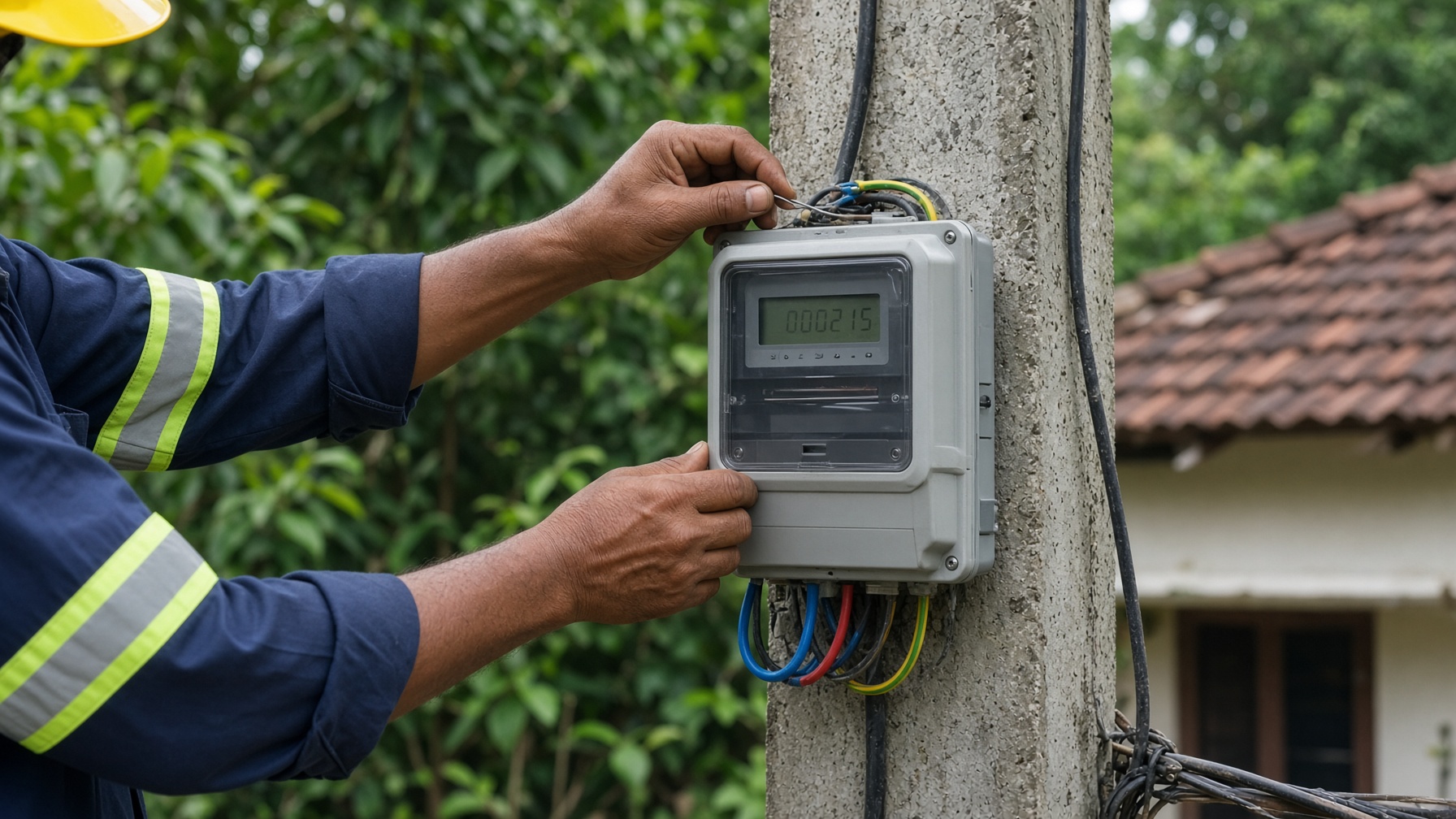
KSEB supplies about 1.37 crore consumers. Under the Revamped Distribution Sector Scheme the Ministry of Power approved smart meters on that system: system meters on feeders and distribution transformers, and prepaid smart meters for consumers. The full project was estimated at ₹8,175 crore. The official plan began with 37 lakh consumer meters. The Ministry put the life-cycle cost of one consumer meter, over 93 months, at ₹6,000.
The method first chosen was TOTEX. A private AMI service provider pays for the meters, the software and the communication, takes a 15 per cent central grant, and recovers the rest from the Board in monthly instalments for 93 months. For the full programme that grant was worked out as ₹1,226.26 crore. The Board’s management, then headed by an IAS officer as Chairman and Managing Director, treated TOTEX as an order that had to be followed.
EEFI read the same plan as a separation of content from carriage. The wires would stay with the public utility. Metering, billing and collection would move to a private player. That is a back door to privatisation of distribution. Network strengthening under RDSS receives a 60 per cent grant. Smart metering was offered only 15 per cent. Working meters did not have to be replaced all at once. KSEB staff could install. K-FON could carry the data. The Board’s own data centre could store it. C-DAC’s tools deserved a trial. None of this required a project agency sitting above the Board.
Despite the protests, KSEB issued a TOTEX tender on 1 April 2023 for 37 lakh meters: system meters, meters of government institutions, high-tension consumers, and meters in 14 high-revenue divisions. The probable amount of contract was ₹2,400 crore. The 15 per cent grant on that estimate was about ₹360 crore. Bids opened on 15 May 2023. Three firms took part. Polaris Smart Metering was lowest at ₹3,475 crore — 44.8 per cent above the estimate. After the grant, the Board would still have paid about 30 per cent more than its own figure. The monthly charge, after grant and including GST, for 93 months, would have been ₹79.59 for a single-phase meter, ₹104.09 for a three-phase meter, and between ₹283 and ₹288 for an LT-CT meter or a feeder meter.
The agitation continued. EEFI placed a CAPEX alternative: the utility buys the assets and owns them, employees install, K-FON carries the communication, the data centre is the Board’s, and billing software stays inside. On 25 August 2023 a meeting under the Chief Minister and the Minister for Electricity accepted that alternative. Six decisions were taken. An alternative to TOTEX would be prepared and central approval sought. The first batch would be three lakh meters, for commercial, industrial, government and high-tension consumers, and for feeder, transformer and boundary meters. KSEB would develop its own billing-related services. K-FON would be used. The Board’s data centre would store the information. KSEB employees would install the meters.
An IT advisory committee then drafted the model in two packages. Package-1 was meters, the communication network and the head-end system — the software that first receives raw data from the meters. Package-2 was the meter data management system and the work of linking it to the Board’s other software. On 23 May 2024 the full Board sanctioned ₹277 crore, including the data-centre upgrade. A 60 per cent RDSS grant applied on this route. Before tendering, the estimate was ₹211 crore for Package-1 and ₹10 crore for Package-2. Technical bids opened on 24 October 2024 and 15 November 2024. Six firms bid in each package. Every category of meter was tested at the Thirumala TMR wing with SMITHA — Smart Meter Integrated Testing and Higher Analysis — developed by C-DAC and CPRI, instead of proprietary test software. This was the first time an Indian power utility used SMITHA for the purpose. Financial bids opened on 17 January 2025. Package-1 came in at ₹160.9 crore from Iskraemeco, 23.74 per cent below estimate. Package-2 came in at ₹4.45 crore from Easiasoft, 55.5 per cent below. The claim that a tender outside TOTEX would fail, or would cost more, was shown to be wrong.
Phase I monthly cost for 93 months, CAPEX against the 2023 TOTEX rate. The CAPEX figure includes installation and data storage by KSEB. The TOTEX figure is the rate after grant, including GST. Whole-current meters measure load directly. CT/PT meters work with current and potential transformers.
Single-phase whole-current smart meter (5–30 A), with net metering — 1,50,000 meters. CAPEX ₹59.98 a month. TOTEX ₹79.59. TOTEX higher by 32.69 per cent.
Three-phase whole-current smart meter (10–60 A) — 35,000 meters. CAPEX ₹73.34. TOTEX ₹104.09. TOTEX higher by 41.94 per cent.
Three-phase whole-current smart meter (10/20–100 A) — 2,000 meters. CAPEX ₹73.34. TOTEX ₹104.09. TOTEX higher by 41.94 per cent.
Three-phase LT-CT consumer meter, accuracy class 0.5S — 1,100 meters. CAPEX ₹112.54. TOTEX ₹283.00. TOTEX higher by 151.46 per cent.
Three-phase CT/PT high-tension consumer meter, accuracy class 0.2S — 7,630 meters. CAPEX ₹210.24. TOTEX ₹286.79. TOTEX higher by 36.41 per cent.
Three-phase LT-CT distribution-transformer meter, 0.5S — 91,760 meters. CAPEX ₹116.98. TOTEX ₹283.00. TOTEX higher by 141.92 per cent.
Three-phase CT/PT feeder meter, accuracy class 0.5S — 3,000 meters. CAPEX ₹130.31. TOTEX ₹288.20. TOTEX higher by 121.17 per cent.
Three-phase CT/PT boundary meter, accuracy class 0.5S — 1,200 meters. CAPEX ₹130.31. TOTEX ₹288.20. TOTEX higher by 121.17 per cent.
The extra under TOTEX was largely the finance charge and profit of the service provider. KSEB was still doing installation and data storage under CAPEX, and the TOTEX price was far higher. Rates for the meter-data software were already secured for up to 50 lakh consumers, so later phases do not need a fresh tender for that package. C-DAC’s head-end system, SEEMA, is on pilot at no licence cost. The Board will meet only the cost of later updates. In future tenders the purchase can be confined to the meters, with every other function kept inside the utility.
Phase I of three lakh meters went ahead. In February 2026 the then LDF government tendered Phase II: “Smart Meters and Allied Software and Communication Infrastructure — AMI Project Phase II”, tender 2026_KSEB_828557_1, fifty lakh meters. The tender was still live when the May 2026 election brought the UDF into office. Pressure then built to cancel it and return to TOTEX. The unions in Kerala told the government they would not watch that move in silence.
A second line appeared in sections of the media: that the incoming leadership was in collusion with Adani, and that Adani would be given the work. A chartered-flight journey of the Chief Minister-designate, and a meeting with Adani officials at Mangalore, were held up as evidence. Adani Power was one of the companies in the tender, which gave the story a surface. EEFI treated the campaign as a device. If the tender were attacked as a nexus, the government would have a public reason to scrap it and roll the project back to TOTEX. The note records that, on tracing the reports, the rumour was being spread from the Adani side as a trick. The unions did not walk into that. The tender was not cancelled.
Financial bids opened on 5 September 2026. Eleven firms took part. One failed the technical stage. The completion period is 2,880 days. The note gives these bids.
GridCrest Technologies is lowest (L1) at ₹3,241 crore.
Infinite Computer Solutions is second (L2) at ₹3,461 crore.
Kimbal is third at ₹3,643 crore, about 12.4 per cent above L1.
Linkwell Telesystems quoted ₹3,831 crore. Allied Engineering Works quoted ₹4,218 crore. HPL Electric & Power quoted ₹4,593 crore. Genus Power Infrastructures quoted ₹4,985 crore.
Adani, having cleared the technical stage, finished tenth — last among those qualified. That ranking is the factual answer to the claim that the tender had been written for one house.
When installation, finance, the meter-data system and storage are counted as they fall under CAPEX, the average is about ₹2,800 a meter. A smart-meter programme below ₹3,000 a meter is a record in India, and roughly one-fourth to one-fifth of the TOTEX rates of 2023. On 26 September 2026 the ministerial meeting on power, at Kochi, approved continuation of smart metering in Kerala on the CAPEX mode. That decision closes, for the present, the attempt to drag the Board back into TOTEX.
EEFI did not oppose the meter. It opposed the contract form that would have taken metering and revenue out of the utility. A smart meter on a weak line does not by itself give supply every hour. The work should proceed in stages, with pilot testing, and with the public utility in charge. Phase I showed that an Indian utility can buy meters and software on CAPEX, use public tools such as SMITHA, K-FON, the Board’s data centre and, in time, SEEMA, and still beat the TOTEX price by a wide margin. Phase II has shown that the same model scales to fifty lakh meters. The work now is to finish Phase II on schedule, join the meter-data system to the Board’s own applications, and refuse any fresh attempt — administrative, political, or through planted news — to restore TOTEX. The original note remains attached. The figures are on this page.
Issued by
EEFI Centre